
DUOMO FLORENCE ARCHITECTURE
Duomo Florence – A masterpiece of Gothic & Renaissance architecture
Duomo Florence, also known as Santa Maria del Fiore, is one of Europe’s most significant medieval buildings and one of the largest churches in the world. Together with the Baptistery and Giotto’s Campanile, the Cathedral complex is part of the UNESCO World Heritage Site “Historic Centre of Florence”. It is a beautiful example of Italian Gothic and Renaissance architecture.
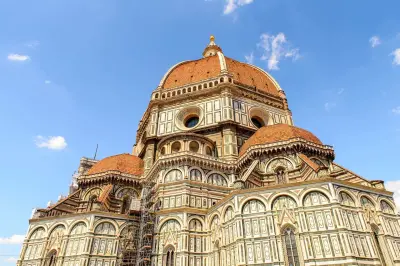
The most prominent and recognizable part is the dome, designed by Filippo Brunelleschi, which blends Gothic and Renaissance elements. The grand facade, completed in the 19th century, shows a Gothic revival style. Together, these architectural styles and the colorful facade make the Duomo a symbol of Florence, highlighting the city’s artistic achievements during the Renaissance.

Santa Maria del Fiore
Construction of Santa Maria del Fiore Cathedral began in 1296 and was largely completed in the 15th century. It can house about 30,000 people and measures approximately 153 meters long and 38 meters wide, with a height of about 90 meters to the inner dome. Brunelleschi’s dome, with its innovative double-shell structure, was a remarkable engineering achievement when it was completed in 1436.
The Duomo complex includes Santa Maria del Fiore (1296-1436), the Baptistery of San Giovanni (built in the 11th century with later renovations), Giotto’s Campanile (constructed between 1334-1359), and the Museo dell’Opera del Duomo (established in 1891). The buildings primarily show Italian Gothic architecture, with some Renaissance details in the dome and Romanesque elements in the Baptistery. The Duomo’s unique facade is in a 19th-century Gothic Revival style, decorated with marble in various colors and other decorations. Visitors must climb 463 steps to reach the dome, while Giotto’s Campanile has 414 steps.

The foundation
The foundation of the Cathedral was laid in 1296 when the city of Florence commissioned architect and sculptor Arnolfo di Cambio to build a new cathedral in the Gothic style in the place of the old cathedral of Santa Reparata, which dates back to the 6th century. Cambio planned to build a large church with three naves and an octagonal dome. The building spanned over several centuries and included many architects. Although the current church looks different from Arnolfo’s original design, it still follows his main ideas.

The structure
The cathedral has a long, open interior with three main aisles divided into four sections leading to a big octagonal space. This space looks similar to the nearby Romanesque Baptistery. Three sides of the octagon have niches with chapels on top. Arnolfo’s design mixes classical and Romanesque styles with a shape similar to that of the Pantheon in Rome. Inside, it feels spacious and grand, with stained windows, pointed arches, and ribbed ceilings supported by solid pillars. This simplicity resembles the Romanesque style, while the pointed arches and tall windows show Gothic influence.

The facade
The initial plan for the facade was to present the Cathedral’s greatness. Arnolfo di Cambio wanted a facade with detailed sculptures and a grand entrance. His ideas can be seen in a 16th-century drawing at the Museum of the Opera del Duomo. However, due to many delays and design alterations, the facade was not completed for long. The current facade, completed in the late 19th century by Emilio De Fabris, is more elaborate and follows a Gothic Revival style, which differs from Arnolfo’s original vision. Constructed with colorful marble, the facade harmonizes with the Cathedral and nearby buildings, including the Bell Tower and Baptistery. “Rosso di Siena” marble, visible on the facade, reflects national pride and the colors of a unified Italy.

The dome – A symbol of Renaissance innovation
The famous dome of the Duomo, designed by Filippo Brunelleschi, combines Gothic and Renaissance styles and presents a significant architectural achievement. Construction started in 1420, and the big challenge was how to build the dome of such immense proportions without using temporary wooden supports, usually needed for massive structures. Brunelleschi proposed a double-shell design with an inner and outer dome, which helped distribute the weight and made it possible to build the structure without traditional wooden centering. He used innovative engineering techniques, including ribs and chains, to stabilize the dome and invented cranes to lift heavy stone blocks without outside support. After 16 years, the dome was completed in 1436, symbolizing creativity and inspiration.

Brunelleschi’s lasting legacy
Brunelleschi’s influence on Italian architecture is significant and goes beyond the dome. He improved perspective drawing and design, and his work inspired many architects. His work was vital in shaping the Renaissance and a new era of creativity in Italian design. Brunelleschi’s tomb can be seen inside the cathedral, with reliefs celebrating his work.
The staircase
The staircase leading to the dome of the Duomo di Firenze is narrow and winding, with 463 steps. It provides a way through the dome’s structure, allowing visitors to view the beautiful frescoes.

The Last Judgment frescoes
The Duomo complex features many frescoes, particularly in the interior of the Cathedral. The most impressive ones are found inside the dome. Created by Giorgio Vasari and Federico Zuccari in the 16th century, the frescoes show the Last Judgment and cover the entire interior of the dome. The scenes present Biblical stories of salvation and judgment, highlighting the cathedral’s religious significance.
Ready to explore the Florence Duomo?

Priority entry
Cathedral of Santa Maria del Fiore Tickets
Skip the lines and explore the Cathedral of Santa Maria del Fiore, one of the largest churches in the world. See Brunelleschi's stunning Dome, decorated with Vasari and Zuccari’s frescoes depicting the Last Judgment. Inside, you'll find 44 beautiful stained glass windows illustrating biblical stories and an exquisite 16th-century marble floor. Don’t miss the iconic bronze Gates of Paradise at the Baptistery and the intricate Gothic facade outside, reflecting the Cathedral's architectural beauty.

Giotto’s Bell Tower
Giotto’s Campanile, or Bell Tower, is a beautiful example of Gothic architecture. It was constructed between 1334 and 1359. The Tower is about 82 meters tall and displays colorful marble and intricate sculptures. Giotto designed the first section, and after his death, Andrea Pisano, Francesco Talenti, and Neri di Fioravante completed it. The facade is made of colorful marble and decorative panels that reflect Gothic influences, and the base has vertical elements to emphasize the height. The overall design shows the artistic innovations of the Italian Renaissance. Visitors can climb 414 steps for stunning views of Florence.

Baptistry of San Giovanni
The Baptistery of San Giovanni, in Piazza del Duomo, is one of Florence’s oldest churches, consecrated in 1059. It is designed in the Romanesque style, with some early Renaissance elements. It has an octagonal shape and is decorated with white Carrara marble and green Prato marble. Initially seen as a pagan temple, it was converted into a Christian site, using elements from Roman buildings. The Baptistery has an eight-sided dome with a flat pyramidal roof inspired by the Church of the Holy Sepulchre. It is decorated with colorful marble, mosaics, and a baptismal basin at the center, with the floor displaying geometric and plant designs.

The Gates of Paradise
The Baptistery of San Giovanni doors are well-known, especially the “Gates of Paradise” by Lorenzo Ghiberti. The gilded bronze doors with ten panels showing Old Testament scenes were completed in 1452 and present important examples of early Renaissance art.
There are also two other doors. The South Door, made by Andrea Pisano between 1330 and 1336, is the oldest and shows the life of St. John the Baptist, while the North Door, also by Ghiberti, has 28 panels featuring New Testament stories. The original doors are kept in the Museo dell’Opera del Duomo for preservation, while replicas can be seen on the Baptistery. These doors don’t just serve functional purposes, they are also beautiful works of art that enrich the cultural heritage of the Baptistery.

Stained glass windows
The stained glass windows in the Cathedral are designed in a Gothic style, showing intricate designs and bright colors. Many of the 44 windows present scenes from the Bible, telling meaningful stories. The windows were created by various artists over the centuries, with some dating back to the 14th century.
Sculptures
Many sculptures within the Duomo complex add to its beauty and express religious themes. The facade includes figures of various saints and prophets. The sculptures in the Cathedral include the Statue of St. John the Baptist by Donatello and a version of the Madonna and Child, which is often attributed to Michelangelo. It is also worth mentioning the sculptures of Four Evangelists created by various artists, Andrea Pisano’s reliefs for the Campanile, Luca della Robbia’s reliefs for the Duomo, and contributions from other Florentine artists.

Basilica of Santa Reparata
The Basilica of Santa Reparata, the former cathedral of Florence, dates back to the 6th century and is located under the Duomo. Although it was consecrated in the 4th century, its current form mainly reflects the 6th century. It resembles early Christian architecture with a simple cross-shaped design and Romanesque elements. The foundation and some preserved remains of Santa Reparata can be explored as part of the Duomo complex. The archaeological site is situated about 2 meters below the Duomo and shows how the original church was transformed into the larger building we see now.
Opera del Duomo Museum
The Museo dell’Opera del Duomo is another important site for Florence’s art and history. Established in 1891, it displays the history of the Cathedral of Santa Maria del Fiore, the Baptistery, and Giotto’s Campanile, offering insights into Florence’s art evolution from the late 13th century to the mid-19th century. The museum features original sculptures by artists like Donatello and Michelangelo, including the original Gates of Paradise, a replica of Arnolfo di Cambio’s Cathedral façade, and Andrea Pisano’s panels for the Campanile. Inside the museum, visitors can engage and learn about the art and techniques with architectural pieces and tools from the Duomo’s construction.
Want to find out more about Duomo’s rich heritage?

Full access to the Duomo Complex
Duomo Florence Small-Group Tour
Join our small group tour to explore one of the largest churches in the world. View its beautiful Gothic facade with Renaissance elements, stunning stained glass windows, and a detailed 16th-century marble floor. Ascend the Dome and Giotto's Bell Tower and enjoy the panoramic views of Florence. Skip the lines to enter the Baptistery and see the famous bronze Gates of Paradise, created by Ghiberti. Visit the Museum and Basilica of Santa Reparata and discover the rich history of the city and valuable artworks, including Michelangelo.

Views from a private terrace
Duomo Tour with VIP Terrace Access
Experience the Duomo with our exclusive VIP tour! Enjoy fast-track access to this iconic landmark and go straight to the top for stunning views from the Northern Terrace and the cupola. This small group tour offers a personalized experience with a knowledgeable guide who will share stories about Filippo Brunelleschi's intricate detailing techniques. Explore the Cathedral's interior, including the Last Judgment frescoes and 44 stained glass windows.